
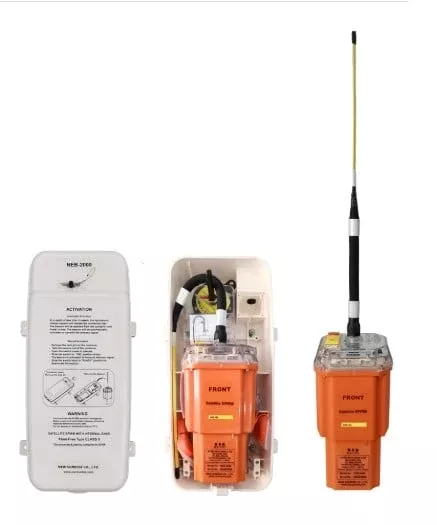
Transmit a satellite distress alert, AIS position reports and a 121.5 MHz homing signal from one float-free emergency beacon.
The NSR NEB-2000 combines a 406 MHz EPIRB, dual-channel AIS transmitter and multi-constellation GNSS receiver. It can deploy automatically through its hydrostatic release enclosure or be activated manually.
Key benefits
- Multi-system alerting: Uses 406 MHz satellite distress transmission, AIS1/AIS2 messages and a 121.5 MHz homing signal.
- Automatic deployment: The hydrostatic release system activates at a maximum depth of 4 m.
- Extended emergency operation: The specified battery supports at least 48 hours of operation at -20 °C.
Compatibility and installation
Programming, registration, mounting, inspection and battery or hydrostatic-release replacement must follow the vessel flag requirements and the official NSR documentation. Confirm the exact supplied bracket and coded vessel identity before installation.
Technical specifications
| Model | NEB-2000 |
|---|---|
| 406 MHz transmitter | 406.031 MHz ±1 kHz; 5 W |
| AIS transmitter | 161.975 / 162.025 MHz; 1 W |
| 121.5 MHz homer | 50 mW |
| GNSS | GPS, BDS, GLONASS and Galileo |
| Operating time | At least 48 h at -20 °C |
| Battery | NBT400; storage up to 9 years |
| Hydrostatic release | NHR-100; maximum release depth 4 m |
| Watertightness | 10 m for at least 5 min |
| Beacon size | 116 × 710 × 100 mm |
| Beacon weight | 1.45 kg |
| Operating temperature | -20 to +55 °C |