
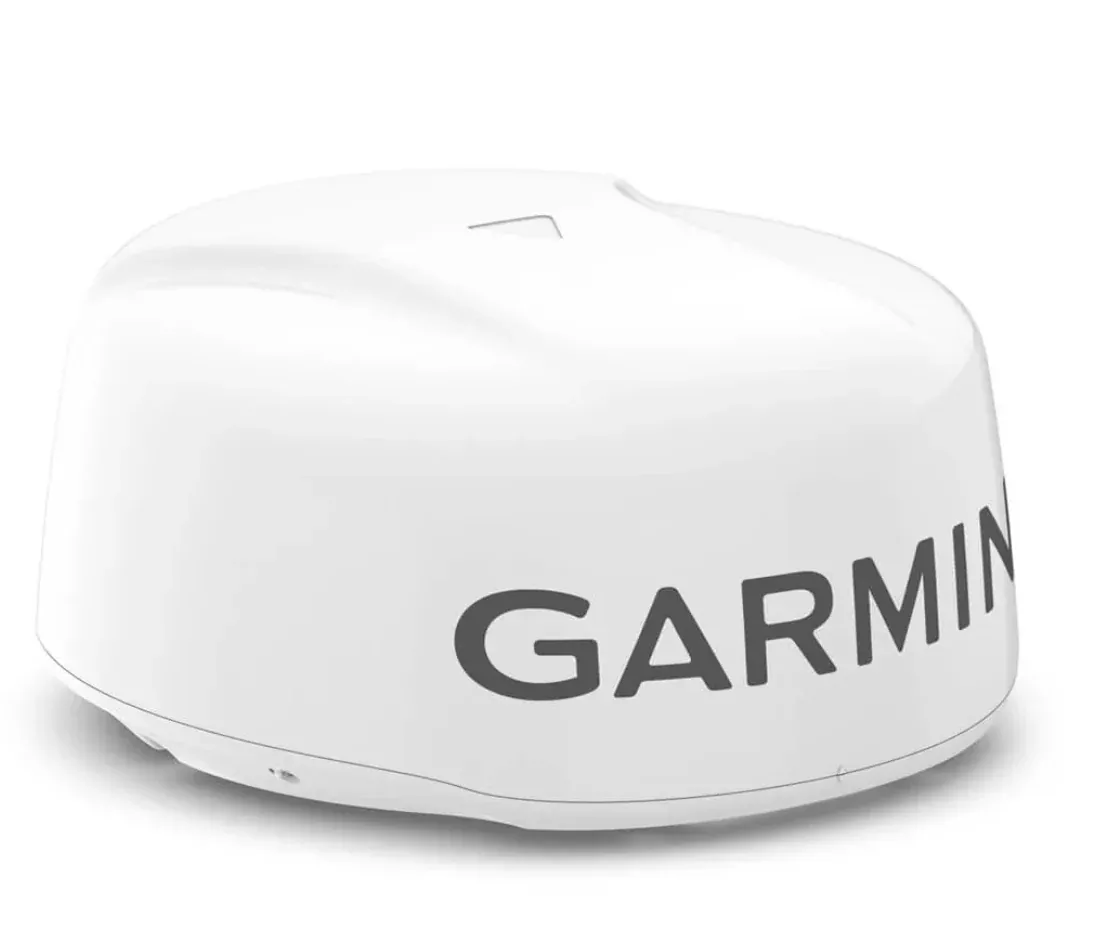
These powerful 18′′ and 24′′ closed antenna radars, full of advanced features usually found in open antenna radars, provide superior detection of traffic, obstacles and weather conditions to offer greater peace of mind in the water.
New exploration media technology
The scanning average, a first in Garmin radars, helps reduce the sea filter and interference to improve the detection and visualization of consistent targets.
Angular adjustment of the size of the lens
The expanded pulse and angular processing techniques of the size of the lens optimize the shapes of the objects on the screen to improve interpretation on all range scales.
Faster exploration antenna
Rotation speeds of up to 60 rpm improve the retracement speed to obtain faster lens updates.
Real echo FOLLOW-UPS
The screen shows a historical “traw” of the navigation of the boats, which eliminates the influence of relative movement to help you quickly identify moving targets and possible collision threats.
Dual scale with radar overlay
The simple radar antenna has the ability to provide split-screen images on your compatible plotter in parallel, with independent controls and range settings for both short and long range. You can superimpose one or both scopes on a card.
Dynamic automatic gain
The gain levels are automatically adjusted to the optimal configuration for ports, areas near the coast and the high seas.
Specifications:
Physical and performance characteristics |
|
| Dimensions of the Unit (WIDTH/HEIGHT/DEPTH) | 18: 508 mm X 248 mm (20″ X 9,8″) 24: 64,5 cm X 24,9 cm (25,4″ X 9,8″) |
|---|---|
| Weight | 18: 7,0 kg 24: 8,7 kg |
| Water Resistance Classification | IPX7 |
| Length of the Antenna | 18: 43 cm (17″) 24: 58 cm (23″) |
| Range of the Antenna | Up to 60 rpm, depending on the settings |
| Anchura del Haz | 18: 5.2° horizontal, 25° vertical 24: 3.7° horizontal, 25° vertical |
| Maximum Scale | 48 nm |
| Minimum Scale | 20 meters |
| Type of Radar | Closed antenna |
Electric |
|
| Feeding Input | 11-32 V cc |
|---|---|
| Energy Consumption, on Hold | 15 W |
| Typical Energy Consumption, Transmitting (in Normal Mode) | 40 W |
| Transmission Power | 4 kW |
Radar functions |
|
| Dual Scale | Yes |
|---|---|
| Superimposition | Yes |
| Compatibility with Dual Radars | Yes |
| Auto Bird Gain | Yes |
| Automatic Profit | Dynamic |
| Target Tracking Marpa (to Avoid Collisions) | Yes (requires a direction sensor, sold separately) |
| Echo Tracking | True |
| Target Size | Yes |
| Exploration MediA |
FAQs
Connect the red wire to the positive (+) battery terminal and the black wire to the negative (-) battery terminal.
You must use a 7.5 A fuse in the in-line fuse holder for safety and to maintain the warranty.
Wear safety goggles, ear protection, and a dust mask when drilling, cutting, or sanding. Avoid drilling into unseen areas.
Check all power connections, the fuse, and ensure proper wire gauge for any extension.
Use: (Distance in mm × 0.222) – 150 = height in mm. Radar base should be at or above this height from roof edge.
The radar should not be mounted closer to a compass than 1.1 m (3.6 ft) for GMR 18 xHD3 and 95 cm (3.1 ft) for GMR 24 xHD3.
Connect the Garmin BlueNet cable to the network port on the device and chartplotter or switch, then tighten locking rings.
Mount the radar out of the range of people, with the beam above head height, and observe the minimum safe distance.
Connect the BlueNet cable to the network port, attach to a Marine Network adapter cable, then to the chartplotter or expander.
If you need to extend the power cable, use 16 AWG for 2 m, 14 AWG for 4 m, and 12 AWG for 6 m extensions to prevent power loss.
Contact the SailRACE team — as certified marine experts we’re happy to help with product selection, installation and after-sales servicing, before and after your purchase.

